
Articles
What Is the Difference Between Slitting and Cut-to-Length Sheet Processing?

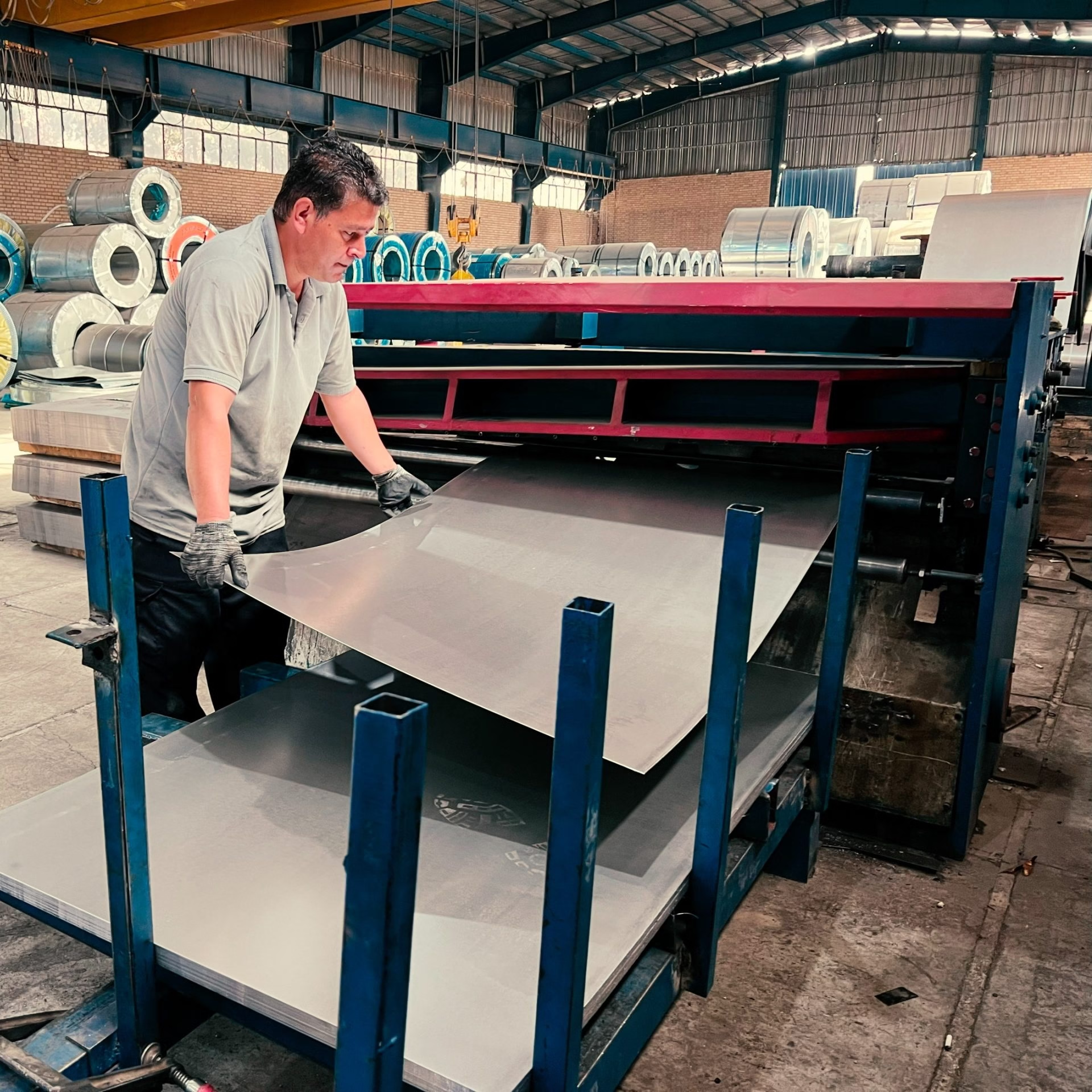
In sheet-cutting orders, “slitting” and “cut-to-length” are sometimes used interchangeably even though their outputs are different. Slitting divides a master coil in the direction of sheet travel into narrower strips or coils. Cut-to-length processing cuts the coil at specified lengths and delivers flat sheets. The correct process therefore starts with the required output form.
Short answer: slitting or cut-to-length?
- Choose slitting when the output must be a strip or narrow coil of custom width.
- Choose cut-to-length or transverse coil cutting when the output must be a flat sheet of custom length.
- If both final width and length must change, the order may require more than one processing stage after technical review.
To prevent mistakes, do not state only the process name in a quotation request. Also specify output form, final width or length, sheet thickness and material, and the required tolerances.
Comparison table: sheet slitting vs cut-to-length processing
| Sheet slitting | Cut-to-length processing | |
|---|---|---|
| Common technical name | Slitting / longitudinal coil cutting | Cut-to-Length / transverse coil cutting |
| Direction of cut | Parallel to coil length and travel | Perpendicular to coil travel |
| Final output | Narrower strip or coil | Flat sheet |
| Principal order dimension | Strip width | Sheet length |
| Common applications | Profiles, tubes, parts, strapping and continuous production lines | Part making, bending, pressing and projects requiring flat sheet |
| Service page | Sheet slitting services | Cut-to-length sheet services |
What is sheet slitting?
In slitting, the master coil is unwound and the sheet passes through a set of knives adjusted to the required finished widths. Cuts run along the coil length, and the output is rewound or packaged as strip. Width consistency, edge condition, burr, surface integrity and output-coil build are important controls.
Slitting is appropriate when the material must enter the next stage at a specified width, for example in profile and tube production, metal components, strapping or continuous-strip manufacturing. See Ghafari sheet slitting services for the process, accepted materials and quotation route.
What is cut-to-length sheet processing?
In cut-to-length processing, the coil is unwound and leveled, then cut transversely at specified lengths. The resulting flat sheets are checked for dimensions and surface condition, stacked and packaged for handling. Finished length, squareness, flatness, edge condition and stacking method are important order requirements.
Cut-to-length is selected when a production line or project requires flat sheet of a specified length, such as component manufacturing, bending, pressing and equipment fabrication. Details are provided on the Ghafari cut-to-length sheet services page.
How should the appropriate service be selected?
When a custom width is required
If the master coil must be divided into several narrower coils or strips, slitting is the primary choice. State master-coil width, each output width, number of cuts, thickness and material type.
When a custom length and flat sheet are required
If the finished product must be delivered as flat sheets of specified length, cut-to-length is the appropriate choice. Finished length, sheet quantity, surface condition, tolerance and packaging method become the main order data.
When both width and length must change
Some orders require a finished output of specified width and length. The processing route depends on master-coil dimensions, equipment limits, material and thickness, and expected quality. Complete specifications must be reviewed before production so the operation sequence and feasibility can be confirmed.
Common stages in controlling a sheet-cutting order
- Inspect the input: Verify sheet type, thickness, width, surface and master-coil data.
- Define the cutting plan: Specify output dimensions, strip or sheet quantities and required tolerances.
- Set up the line: Adjust knives, guides and operating parameters for the order.
- Control production: Check width or length, edges, surface and output form during processing.
- Package and deliver: Secure and package the output for its form, weight and transport conditions.
How does sheet material affect process selection?
The basic distinction between slitting and cut-to-length does not change with material, but setup and quality-control criteria can. Galvanized sheet requires coating protection and scratch control. Oiled sheet and appearance-sensitive surfaces need controlled contact and handling. For stainless steel and aluminum, surface condition, edge burr and equipment compatibility with order thickness and grade must be checked before production.
If the order specifically concerns galvanized sheet, the galvanized steel coil slitting guide explains the information required for that quotation separately.
Information required for pricing and feasibility review
- Sheet type, grade and coating or surface condition
- Thickness and width, plus master-coil weight and identification where available
- Finished strip widths for a slitting order
- Finished sheet lengths and quantities for a cut-to-length order
- Dimensional tolerance, burr limit and surface sensitivity
- Order quantity, required timing and packaging or delivery method
Common mistakes when placing an order
- Relying on a process name without defining the output: Market use of “longitudinal” and “transverse” cutting can vary; state the required product form clearly.
- Omitting tolerances: “Accurate” is not measurable; provide an acceptance criterion or technical drawing.
- Ignoring surface and edge requirements: Appearance sensitivity, burr limit and coating condition must be defined before production.
- Leaving packaging undefined: Securing, stacking and transport conditions affect the integrity of the output.
Ghafari sheet-processing and storage services
The Ghafari sheet cutting and warehousing services page presents an overview of the facility, slitting, cut-to-length and sheet-storage capabilities. The acceptable technical range must be matched to the current facility data and confirmed for each order, especially when material, thickness, dimensions or tolerances are outside common conditions.
Download the sheet-cutting quotation checklist
Complete this fillable form before sending a quotation request so that master-coil data, output requirements, tolerances, packaging and delivery are not omitted.
Frequently asked questions about slitting and cut-to-length processing
Is slitting the same as longitudinal sheet cutting?
Yes. In this article’s technical definition, slitting is a cut made in the direction of coil travel that divides the master coil into narrower strips or coils.
Is cut-to-length the same as transverse coil cutting?
Yes. In cut-to-length processing, the cut is perpendicular to coil travel so flat sheets of specified length are produced.
Which service is required to produce galvanized strip?
If a galvanized coil must be divided into narrower coils of specified width, slitting is required. Coating type, thickness, finished widths, tolerances and packaging method must be included in the order.
Are finished dimensions alone sufficient for an order?
No. Sheet material and grade, surface condition, master-coil dimensions and weight, tolerances, order quantity and packaging conditions are also required for feasibility and pricing.
How are slitting and cut-to-length prices calculated?
Price depends on coil data, material type and thickness, cutting pattern, number of outputs, order quantity, tolerances and packaging requirements. Actual order specifications must be reviewed for an accurate quotation.
Slitting produces narrow strip or coil of custom width, while cut-to-length processing produces flat sheet of custom length. If the process is still uncertain, prepare the output form and master-coil data for technical review and continue through the relevant slitting or cut-to-length service page.